Article
Article
India’s BFSI Workforce Is Expanding Fast — Are Verification Standards Keeping Up?
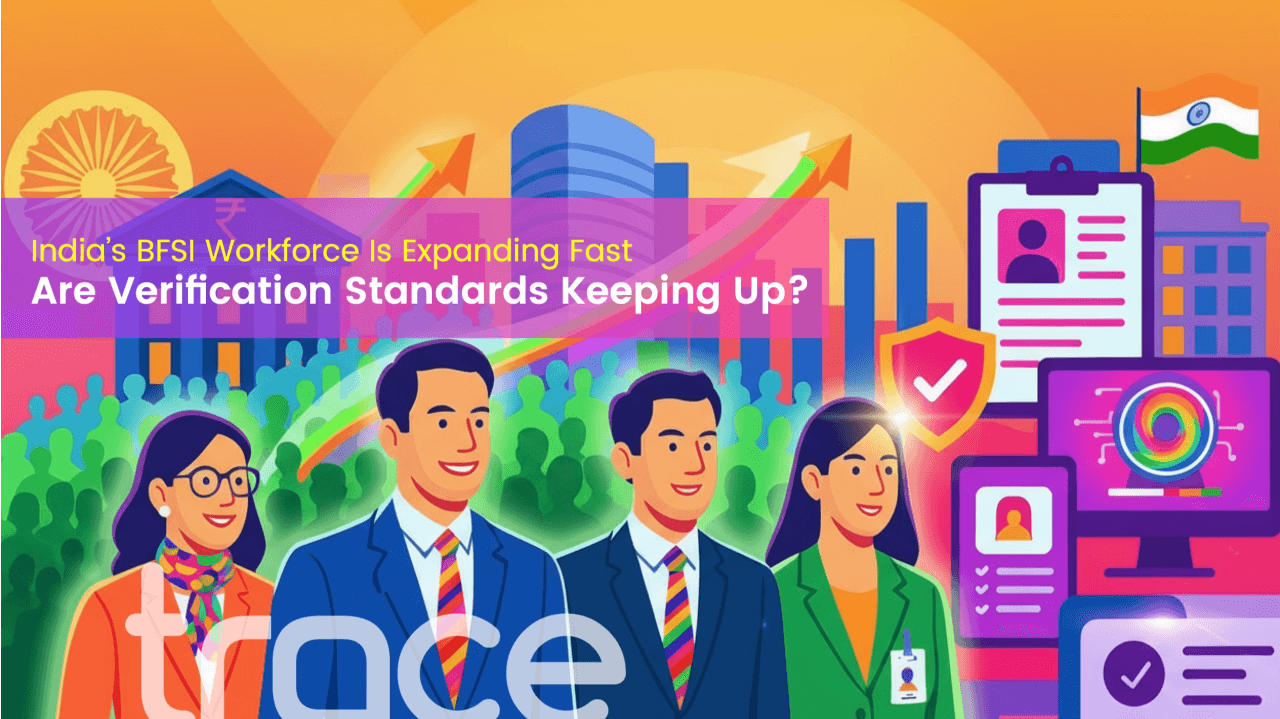
India’s banking, financial services and insurance (BFSI) sector is hiring at a brisk pace. New digital products, aggressive branch expansion in semi-urban and rural markets, and a surge in fintech activity mean more salespeople, recovery agents, field collection staff and third-party distribution partners are working at the "last mile". That growth creates opportunity — and risk. Are verification and onboarding standards evolving quickly enough to keep fraud, compliance lapses, and reputational damage at bay?
India’s banking, financial services and insurance (BFSI) sector is hiring at a brisk pace. New digital products, aggressive branch expansion in semi-urban and rural markets, and a surge in fintech activity mean more salespeople, recovery agents, field collection staff and third-party distribution partners are working at the "last mile". That growth creates opportunity — and risk. Are verification and onboarding standards evolving quickly enough to keep fraud, compliance lapses, and reputational damage at bay?
Hiring at scale — the challenge
Recent reports show large employment gains across the economy and continued growth in BFSI hiring, including meaningful increases in entry-level and field roles. Rapid scaling puts pressure on recruiters to move quickly, often relying on contract staffing and third-party partners to fill field positions.
Speed + Outsourcing = Gaps in due diligence that fraudsters and bad actors can exploit.
Why feet-on-street (FOS) roles are high-risk
FOS roles — sales agents, recovery staff, ATM cash-in/transit guards, business correspondents and collection agents — have direct customer contact, access to sensitive customer data, and sometimes the authority to collect documents or cash. A compromise in that cohort can lead to:
Identity theft and account takeover via forged KYC documents
Creation of mule accounts and fraudulent disbursements
Mis-selling of products that triggers regulatory scrutiny and customer complaints
Reputational damage and client churn
Regulators and large banks have recognized the problem
Banks are increasing background checks on employees and agents as mule accounts and fraud rise.
The regulatory backdrop: standards are tightening — but unevenly applied
Indian regulators have moved to tighten controls around third-party risk, AML/CFT, and information security — all relevant to field workers and outsourced partners. IRDAI’s and RBI’s evolving guidance and industry circulars emphasize vendor due diligence, AML controls, and secure handling of customer data. However, guidance often focuses on institutional controls; translating that into consistent, pan-India field-force screening practices is uneven across incumbents and new entrants.
The real-world cost of weak verification
Beyond regulatory notices and process fixes, weak screening has hard financial consequences. Studies and industry analyses point to
rising instances of employment-related fraud that cost companies millions in remediation, customer refunds, legal exposure, and re-hiring.
Public reporting and industry studies show
a growing incidence of forged documents and identity manipulation detected during background checks.
The practical impact is clear: a single serious mis-hire in a critical role (e.g., collections or branch operations) can cost multiple times the employee’s salary when you account for lost productivity, remediation and reputational fallout.
Why traditional background checks often fall short
Many banks and insurers still rely on a patchwork of manual checks:
Verifying identity documents visually or via e-KYC only at hiring time
Calling past employers (which can be spoofed or incomplete)
Relying on local references or contractor attestations
These approaches miss sophisticated forgeries (tampered PDFs, fake referencing), identity theft rings, and the subtle manipulation of digital records.
Additionally, background checks are sometimes skipped or abbreviated for short-term contractors to speed onboarding.
Practical steps organizations must take — a checklist
Standardize verification across all worker types (employee + contractor + vendor) — treat FOS the same as in-house staff for background checks.
Use multi-vector identity verification — combine Aadhaar (when lawful and permitted), PAN, phone-number and device signals, and third-party identity databases.
Automate forgery detection and metadata analysis — use tools that detect edited PDFs, image manipulations, and mismatched metadata rather than relying solely on human eyeballing.
Continuous monitoring, not one-time checks — run periodic re-screening and exception alerts for high-risk cohorts.
Vendor governance and SLAs — enforce contractual obligations with staffing vendors requiring full verification, audit rights, and penalties for lapses.
Integration with AML and fraud teams — link verification outputs to AML transaction monitoring and fraud alert systems to spot correlated anomalies.
Proportionate checks by role criticality — while some checks can be streamlined for low-risk roles, roles with financial/customer access require the highest scrutiny.
Clear audit trails and evidence capture — store verification artifacts securely for regulatory inspection and incident response.
Tech + human blend wins
Technology can scale checks and detect falsified documents far faster than manual reviewers. But human validation remains essential for edge cases and contextual judgment (for example, anomalous but legitimate background details). Leading organizations pair AI-based document forensics and automation with a small, expert human review desk for escalations.
Building the business case for stronger verification
Risk teams can quantify the return on investment by modeling:
Average cost per mis-hire (loss of productivity, remediation, re-hiring)
Probability reduction in mis-hires from improved screening
Downside avoided (regulatory fines, client churn)
This ROI often justifies modest investments in verification tech and vendor governance — particularly in high-volume field operations where a few bad actors can scale damage quickly. Industry studies and regulatory focus on employment fraud make the business case stronger.
Closing thoughts — speed is a feature, not an excuse
India’s BFSI sector is rightly ambitious about growth. But speed must not be a pretext for lax due diligence. Treating feet-on-street workers as trusted parts of the institution — and investing in consistent, tech-enabled verification and continuous monitoring — protects customers, preserves brand trust, and prevents avoidable financial loss. Regulators are expecting more, and the institutions that get verification right now will not only reduce risk but gain an operational advantage in customer trust and regulatory resilience.
#traceBGV #BFSIBGV #BFSI #BankingIndia #FinancialServices #InsuranceIndia #IndianBanking #FinTechIndia #BackgroundVerification #EmployeeVerification #ComplianceStandards #RiskManagement #DueDiligence #IdentityVerification #WorkforceCompliance #VerificationTechnology #HRTech #RegTech #ComplianceTech #TalentVerification #EmploymentScreening #BusinessGrowth #IndustryInsights
Hiring at scale — the challenge
Recent reports show large employment gains across the economy and continued growth in BFSI hiring, including meaningful increases in entry-level and field roles. Rapid scaling puts pressure on recruiters to move quickly, often relying on contract staffing and third-party partners to fill field positions.
Speed + Outsourcing = Gaps in due diligence that fraudsters and bad actors can exploit.
Why feet-on-street (FOS) roles are high-risk
FOS roles — sales agents, recovery staff, ATM cash-in/transit guards, business correspondents and collection agents — have direct customer contact, access to sensitive customer data, and sometimes the authority to collect documents or cash. A compromise in that cohort can lead to:
Identity theft and account takeover via forged KYC documents
Creation of mule accounts and fraudulent disbursements
Mis-selling of products that triggers regulatory scrutiny and customer complaints
Reputational damage and client churn
Regulators and large banks have recognized the problem
Banks are increasing background checks on employees and agents as mule accounts and fraud rise.
The regulatory backdrop: standards are tightening — but unevenly applied
Indian regulators have moved to tighten controls around third-party risk, AML/CFT, and information security — all relevant to field workers and outsourced partners. IRDAI’s and RBI’s evolving guidance and industry circulars emphasize vendor due diligence, AML controls, and secure handling of customer data. However, guidance often focuses on institutional controls; translating that into consistent, pan-India field-force screening practices is uneven across incumbents and new entrants.
The real-world cost of weak verification
Beyond regulatory notices and process fixes, weak screening has hard financial consequences. Studies and industry analyses point to
rising instances of employment-related fraud that cost companies millions in remediation, customer refunds, legal exposure, and re-hiring.
Public reporting and industry studies show
a growing incidence of forged documents and identity manipulation detected during background checks.
The practical impact is clear: a single serious mis-hire in a critical role (e.g., collections or branch operations) can cost multiple times the employee’s salary when you account for lost productivity, remediation and reputational fallout.
Why traditional background checks often fall short
Many banks and insurers still rely on a patchwork of manual checks:
Verifying identity documents visually or via e-KYC only at hiring time
Calling past employers (which can be spoofed or incomplete)
Relying on local references or contractor attestations
These approaches miss sophisticated forgeries (tampered PDFs, fake referencing), identity theft rings, and the subtle manipulation of digital records.
Additionally, background checks are sometimes skipped or abbreviated for short-term contractors to speed onboarding.
Practical steps organizations must take — a checklist
Standardize verification across all worker types (employee + contractor + vendor) — treat FOS the same as in-house staff for background checks.
Use multi-vector identity verification — combine Aadhaar (when lawful and permitted), PAN, phone-number and device signals, and third-party identity databases.
Automate forgery detection and metadata analysis — use tools that detect edited PDFs, image manipulations, and mismatched metadata rather than relying solely on human eyeballing.
Continuous monitoring, not one-time checks — run periodic re-screening and exception alerts for high-risk cohorts.
Vendor governance and SLAs — enforce contractual obligations with staffing vendors requiring full verification, audit rights, and penalties for lapses.
Integration with AML and fraud teams — link verification outputs to AML transaction monitoring and fraud alert systems to spot correlated anomalies.
Proportionate checks by role criticality — while some checks can be streamlined for low-risk roles, roles with financial/customer access require the highest scrutiny.
Clear audit trails and evidence capture — store verification artifacts securely for regulatory inspection and incident response.
Tech + human blend wins
Technology can scale checks and detect falsified documents far faster than manual reviewers. But human validation remains essential for edge cases and contextual judgment (for example, anomalous but legitimate background details). Leading organizations pair AI-based document forensics and automation with a small, expert human review desk for escalations.
Building the business case for stronger verification
Risk teams can quantify the return on investment by modeling:
Average cost per mis-hire (loss of productivity, remediation, re-hiring)
Probability reduction in mis-hires from improved screening
Downside avoided (regulatory fines, client churn)
This ROI often justifies modest investments in verification tech and vendor governance — particularly in high-volume field operations where a few bad actors can scale damage quickly. Industry studies and regulatory focus on employment fraud make the business case stronger.
Closing thoughts — speed is a feature, not an excuse
India’s BFSI sector is rightly ambitious about growth. But speed must not be a pretext for lax due diligence. Treating feet-on-street workers as trusted parts of the institution — and investing in consistent, tech-enabled verification and continuous monitoring — protects customers, preserves brand trust, and prevents avoidable financial loss. Regulators are expecting more, and the institutions that get verification right now will not only reduce risk but gain an operational advantage in customer trust and regulatory resilience.
#traceBGV #BFSIBGV #BFSI #BankingIndia #FinancialServices #InsuranceIndia #IndianBanking #FinTechIndia #BackgroundVerification #EmployeeVerification #ComplianceStandards #RiskManagement #DueDiligence #IdentityVerification #WorkforceCompliance #VerificationTechnology #HRTech #RegTech #ComplianceTech #TalentVerification #EmploymentScreening #BusinessGrowth #IndustryInsights